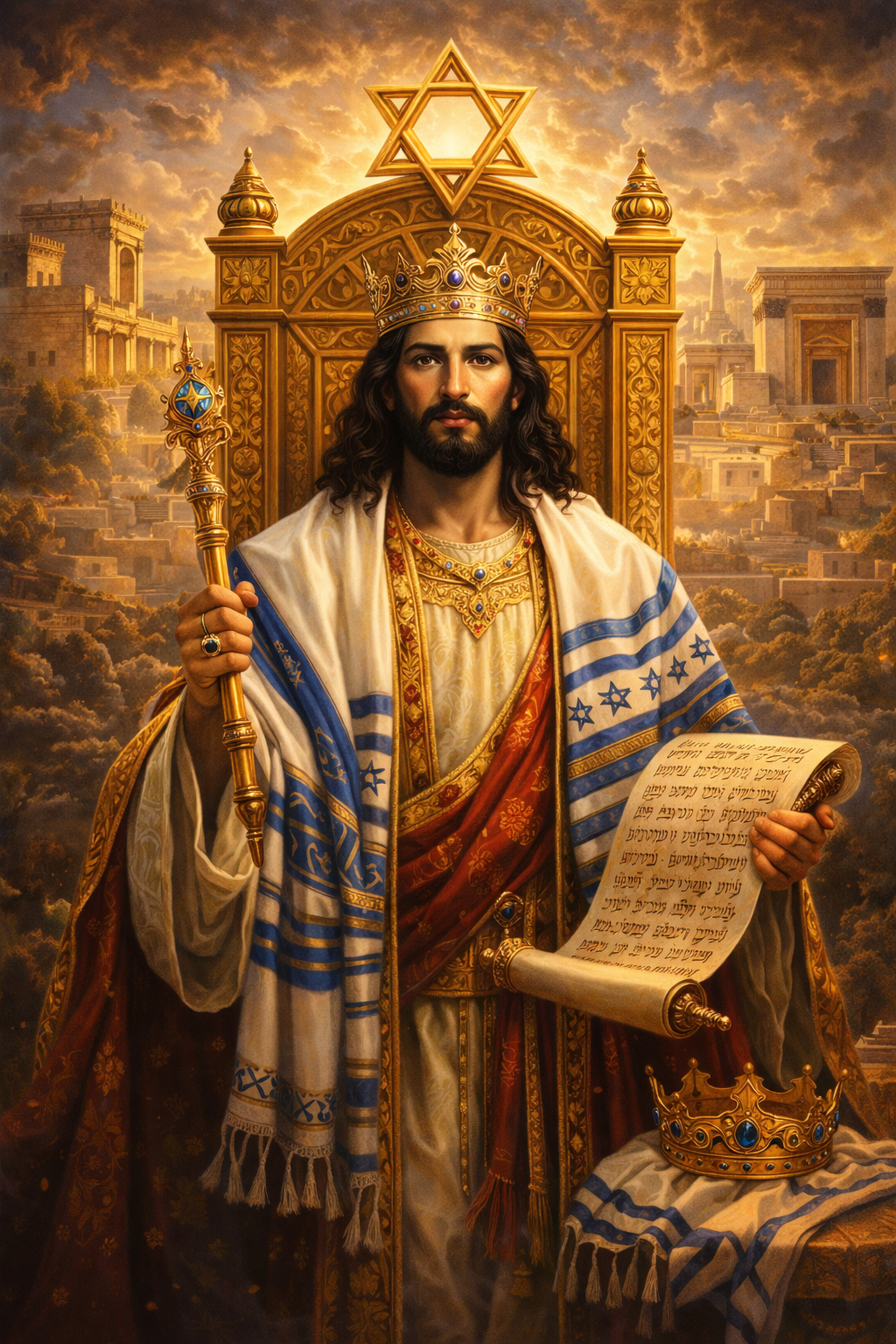
Jesus, the Davidic King
A Victorious Ruler-King Announced from the Very Beginning
From the very beginning of Scripture, God revealed His plan to restore the authority humanity lost through the Fall. When Adam and Eve disobeyed God in the Garden of Eden, they forfeited their God-given dominion over the earth. That authority was seized by the serpent, later identified in Scripture as the ruler of this world. Yet even in the moment of humanity’s failure, God declared His redemptive purpose.
Genesis 3:15 reveals the first Messianic promise: the offspring of the woman would crush the serpent’s head. This prophecy speaks of a coming Messiah who would reclaim dominion, restore authority, and overthrow the serpent’s rule. Often referred to as the Protoevangelium, or “first gospel,” this verse introduces the Messiah as a conquering Seed who would decisively defeat the enemy.
This is not merely symbolic or spiritual language—it is royal and judicial language. To crush the serpent’s head implies authority, dominion, judgment, and final victory. From the very beginning, the Messiah is revealed not only as a redeemer, but as a victorious Ruler-King who would overthrow evil and restore God’s rightful order on the earth.
Jesus Christ: The Chosen King of Israel and Ruler of the Nations
The Church rightly proclaims Jesus Christ as Savior—crucified, risen, and exalted—the One who redeems humanity from sin and restores us to the Father. This truth stands at the very heart of the gospel. However, Scripture reveals that new birth in Christ is not the conclusion of God’s redemptive plan, but its beginning.
The believer is born again into a kingdom under the rule of one King—a kingdom that will one day be fully manifested physically on the earth. For this reason, it is imperative that believers undergo the process of sanctification and grow in spiritual maturity, preparing themselves to rule and reign with Christ in the age to come.
Alongside the work of the cross stands another essential and inseparable aspect of Jesus’ identity: He is the Messiah-King of Israel—chosen, anointed, and appointed by God to rule visibly and physically over the earth. This kingly role is foundational to both Old and New Testament theology, though it is often underemphasized in modern Christian teaching.
The prophets of Israel and the apostles of the early Church clearly understood that the Messiah was not only a suffering Servant, but also a righteous Ruler. He would establish a real kingdom, reign from Jerusalem, bring peace and order to the nations, and delegate authority to His people so that they might reign with Him under the Word of God
The Prophetic Revelation of a Righteous King
The prophets of Israel expanded this promise by revealing that the Messiah would be a King—not only spiritually, but physically—ruling over Israel and the nations.
Isaiah 9:6–7 declares that a Son would be born whose government would rest upon His shoulders. The increase of His government and peace would have no end, and He would reign on the throne of David over a real kingdom. This prophecy points to an actual, earthly rule, since David himself was a physical king ruling a physical nation.
Isaiah 2 describes a day when this ruler will judge between the nations and settle disputes for many peoples. In that day, swords will be beaten into plowshares and spears into pruning hooks. Nation will no longer rise against nation, nor will they train for war anymore. This ruler will bring true peace to the earth after ages of chaos, warfare, and injustice.
Jesus as the Son of David and Heir to the Throne
God further narrowed this promise through King David, a man uniquely described as king, shepherd, and prophet. David physically ruled Israel, united the tribes, governed from Jerusalem, and established justice in the land. God made a covenant with David that extended far beyond his lifetime:
“Your house and your kingdom shall be made sure forever before Me.
Your throne shall be established forever.”
— 2 Samuel 7:16
David understood that this promise spoke of a future ruler greater than himself. Psalm after psalm points forward to a coming King whose reign would be eternal, righteous, and universal (Psalm 2; Psalm 72; Psalm 110).
Isaiah 11:1–9 further clarifies the identity of this ruler, describing Him as a shoot coming from the stump of Jesse, David’s father. This confirms that the Messiah would be a descendant of David and would rule with righteousness, justice, and divine wisdom. Under His reign, the earth would be filled with the knowledge of the Lord.
To be called “the Son of David” is therefore not merely symbolic. It is a royal claim signifying rightful heir to David’s throne, fulfillment of the Davidic covenant, and legitimate King of Israel.
The New Testament affirms that Jesus of Nazareth fulfills these prophecies. Matthew 1:1 establishes His lineage as descending from David, which is essential because Scripture teaches that the scepter belongs to Judah and to the house of David. Only someone born from this lineage could legally inherit the throne.
Luke 1:32–33 records the angel Gabriel’s declaration that Jesus would be given the throne of His father David and would reign over the house of Jacob forever. This promise is not limited to spiritual authority alone; it speaks of an everlasting kingship rooted in God’s covenant with Israel.
The Apostolic Expectation of a Restored Kingdom
The disciples themselves understood the Messianic hope as the restoration of Israel’s kingdom. They expected the Messiah to reunite and restore the Kimgdom of Israel that had been divided since the days of Solomon.
Acts 1:6 records the disciples asking Jesus whether He would restore the kingdom to Israel at that time. Their question reflects the widespread prophetic expectation of a coming ruler who would reunite the tribes and establish peace and righteousness. This expectation aligns with Ezekiel 37:15–28, where God promises to reunite the divided kingdom under one king—a descendant of David—who would shepherd His people forever.
Ezekiel 37 22 -25”I will make them one nation in the land, on the mountains of Israel. There will be one king over all of them and they will never again be two nations or be divided into two kingdoms. 23 They will no longer defile themselves with their idols and vile images or with any of their offenses, for I will save them from all their sinful backsliding, and I will cleanse them. They will be my people, and I will be their God. 24 “‘My servant David will be king over them, and they will all have one shepherd. They will follow my laws and be careful to keep my decrees. 25 They will live in the land I gave to my servant Jacob, the land where your ancestors lived. They and their children and their children’s children will live there forever, and David my servant will be their prince forever. “
The Messiah’s Global Reign from Jerusalem
The prophetic vision extends beyond Israel to all nations. Scripture reveals that the Messiah will reign as King over the entire earth, with Jerusalem as the center of His rule.
Zechariah 14:9 and Revelation 19:15 declares that the Lord will be King over all the earth. His reign will be universal, extending to every nation. Zechariah 14:17 further explains that the nations will be required to come up to Jerusalem to worship the King, establishing Jerusalem as both the spiritual and governmental center of Messiah’s reign.
The New Testament confirms that Jesus will rule not only in heaven but also on the earth. Revelation 5:10 proclaims that He will reign on the earth, and 2 Timothy 2:12 declares that those who endure with Him will also reign with Him. Together, these passages reveal a future reality in which Christ governs the nations in righteousness, fulfilling every promise spoken by the prophets.
The Certainty of the Coming King
From Genesis to Revelation, Scripture consistently testifies that Jesus Christ is the promised Messiah—the Son of David, the King of Israel, and the Ruler of the nations. Jesus isn’t coming just to rapture us so we can live in heaven, he is actually coming back to defeat his enekies physically and he is staying on the earth to rule it. Jesus restores what was lost in Eden, crushes the serpent’s head, reunites Israel, and establishes God’s kingdom on the earth. As the second Adam he has created a new humanity free from sin and will rule with his redeemed bride (a second Eve) all over the earth.
The Bible leaves no ambiguity: the Messiah’s reign is both spiritual and physical, both heavenly and earthly. Jesus Christ will sit upon the throne of David, rule from Jerusalem, and reign over all the nations in righteousness and peace.